19 September 2026
What is Grounded AI Visibility?
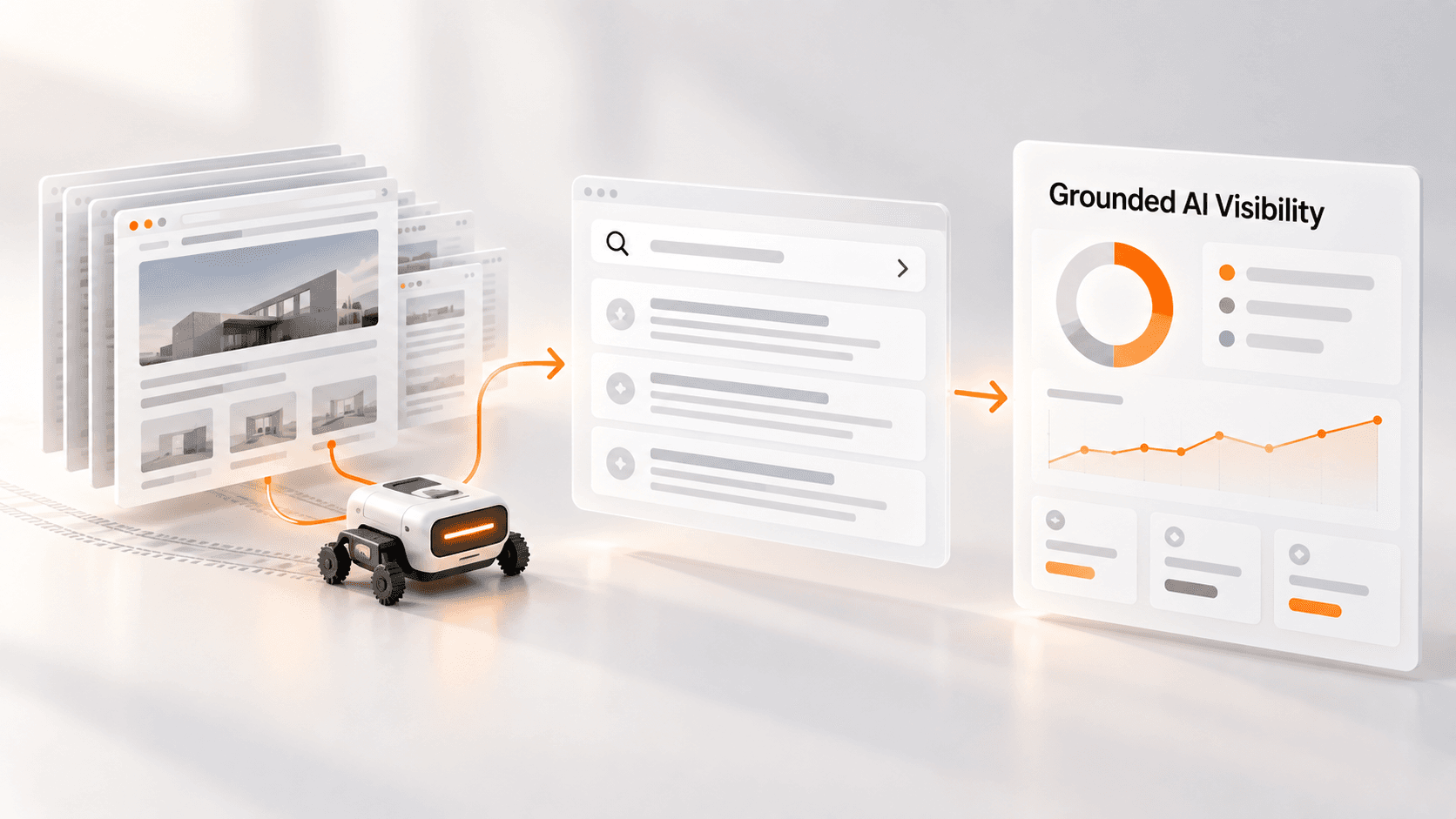
Grounded AI Visibility is LetsGetSurfaced's own name for a simple idea: every recommendation about how your brand shows up in AI search should be backed by a real, page-by-page crawl of your site, not a chatbot's one-shot guess at your homepage. It isn't an industry-standard term. We coined it, and this is the plain answer to what it means, why the wording matters, and how it's actually measured.
What does "grounded" mean here?
It refers to the crawl, not the AI testing itself. Before LetsGetSurfaced tests a single query, it builds a real inventory of your site: starting at the homepage and following internal links page by page, the way a search engine does, up to 500 pages per crawl. It also checks every common place a sitemap can live (a robots.txt directive, sitemap.xml, sitemap_index.xml, wp-sitemap.xml, including index files that point at child sitemaps) and compares that against what the crawl actually found. A page your sitemap lists but nothing links to gets flagged as an orphan, because a page nothing points to is a page a real crawler, or an AI model doing the same job, will never find.
Every recommendation that follows points at a page that's actually in that inventory. It's the difference between "your comparison page needs work" and "write a comparison page", when a comparison page already exists and nobody looked for it first.
That's what the crawl gives us. But the word "grounded" invites a mix-up with a different, newer term already circulating in AI search circles, so it's worth separating the two properly.
How is this different from "AI grounding"?
Since early 2026, "grounding" has been entering AI-search vocabulary as a term for whether a model's own answer used live retrieval or leaned on its training data. That's a property of the model's response, something happening inside ChatGPT's or Gemini's own process, which no outside tool can see or measure.
Grounded AI Visibility isn't that. It's a property of our methodology: our recommendations are grounded in your site, not in anything happening inside a model's retrieval process. The two terms share a word and nothing else. If a description of Grounded AI Visibility ever implies we can see what a model retrieved to build its answer, that description is wrong.
The same care applies to the more common term this sits inside.
How is this different from "AI visibility"?
"AI visibility" is the general, lowercase term for the topic: whether your brand gets mentioned, cited or recommended when people ask AI assistants for suggestions. Most tools in that category work the same way a quick chatbot prompt does. They check whether you show up, without confirming whether the recommendation behind that check is standing on anything real.
Grounded AI Visibility is our name for doing AI visibility measurement a specific way: the testing sits on top of a real crawl, so a recommendation to fix something can point at a page that exists, and a claim that nothing needs fixing means the crawl actually looked and found nothing, not that it never checked.
Between the crawl and the AI testing described above, here's exactly how the two combine into the weekly Briefing.
How is it actually measured?
Two things happen, in a fixed order, on every run, and they combine into one weekly verdict, not a score you have to go and interpret yourself.
Link by link from your homepage, up to 500 pages, checked against your sitemap for orphan pages.
Real buyer queries run against ChatGPT, Claude, Gemini and Perplexity, and every answer is recorded in the model's own words.
One weekly verdict in plain language: what's working, what's costing you visibility, and the priority actions to fix it.
The crawl works link by link from your homepage, the same way a search engine builds its picture, with sitemap discovery across every common variant and technical findings such as broken links, redirect chains and duplicate meta ranked by severity. The AI testing runs the queries a real buyer would actually type against all four engines, and records whether you were mentioned, whether your site was cited, how the mention reads, and which competitors got named instead.
Both feed the Briefing: what's working, what's costing you visibility, and the priority actions to fix it, each one pointing at the actual page or query behind it, not a generic tip. Underneath that sits a GEO readiness score out of 100 (40% mention rate, 35% citation rate, 25% positive-or-neutral sentiment) built from the same fixed queries and scoring on every run, so when the Briefing's verdict changes week to week, it's because something real changed on your site or in how a model answers, not because the question got reworded.
Neither half of the measurement underneath changes on its own for the wrong reasons. The crawl is deterministic: the same site produces the same findings on every run. The AI answers genuinely do vary, because that's how the models themselves behave, but what stays fixed is what gets asked and how the answer gets scored.
That's the whole term, in one sentence: a real crawl underneath, real AI answers on top, synthesised into one verdict, not a dashboard of numbers to go interpret yourself.
A few things worth knowing
Is Grounded AI Visibility an industry-standard term? No. It's LetsGetSurfaced's own name for its approach, not a term you'll find defined elsewhere. If you've seen it used differently somewhere else, that's a different source using the same words for a different idea.
Does Grounded AI Visibility mean LetsGetSurfaced can see what an AI model retrieved to build its answer? No. That's what "AI grounding" means in the wider AI-search industry, and it's a property of the model's own process that no outside tool can observe. Grounded AI Visibility describes our methodology, not theirs: our recommendations are grounded in a real crawl of your site.
How many pages does the crawl actually cover? Every page it can reach by following internal links from your homepage, up to 500 pages per crawl, plus a comparison against your sitemap to catch pages nothing links to.
Which AI models get tested? ChatGPT, Claude, Gemini and Perplexity: the same four engines, the same fixed queries, on every run.
See what AI is actually saying about your site.