27 July 2026 · Updated 19 September 2026
Reading your first AI visibility briefing
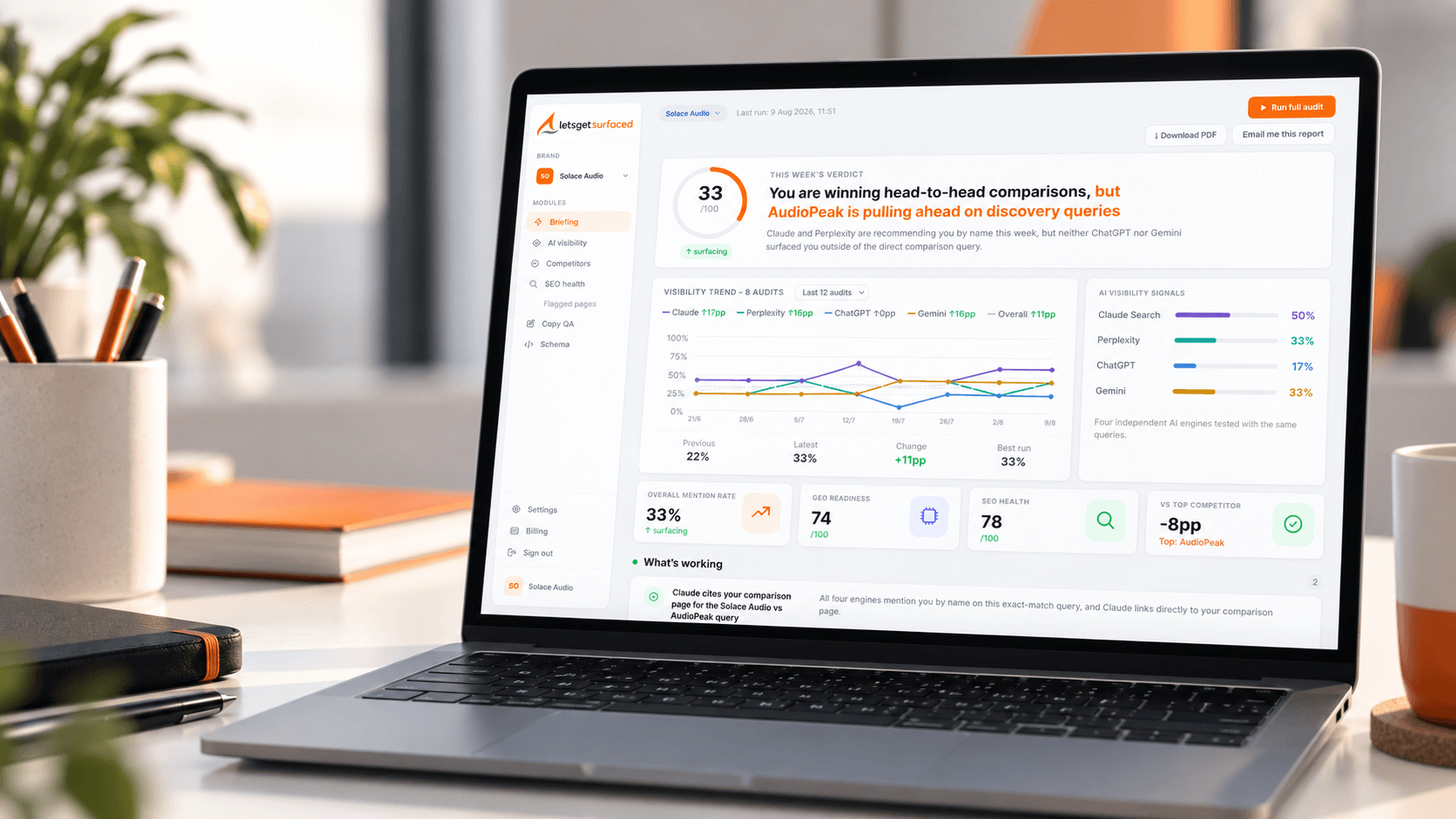
The first time you open a LetsGetSurfaced briefing, it's tempting to jump straight to whichever module has the most alarming number. Don't. The briefing is built to be read in a specific order, and reading it that way is the difference between an hour spent interpreting charts and five minutes spent doing what it already told you to do.
Start with the Briefing itself
The Briefing module is deliberately the homepage of the product, not a summary tacked on at the end. It's what changed this week, why it matters, and the priority actions to take next, before a single chart. Your visibility results, competitor scores and site crawl all feed into this page, and its priority actions point you into the module where each fix actually lives. It isn't a separate report you also have to read.
If you only have five minutes, this is the five minutes.
Then check AI visibility
This is your mention rate across ChatGPT, Claude, Gemini and Perplexity, broken down query by query. For each one, you'll see whether you were mentioned, what the model actually said about you, and, when you weren't, who got recommended in your place.
The useful habit here isn't watching the aggregate number drift up or down. It's looking at the specific query where you lost a mention and asking why, in the model's own words. That's a sharper signal than any score, because it tells you exactly which sentence to fix rather than just that something needs fixing.
Competitors: how you actually stack up
Once you know which query cost you a mention, the Competitors module is where you see the full picture: a mention-rate leaderboard against every competitor you're tracking (or, if you haven't added any, the brands the engines name most often alongside you), and a query-by-query table showing exactly who won each one and by how much. It's a scoreboard, not a diagnosis, and that's exactly what makes it useful: it tells you precisely where you're behind and how that's trending week over week, which is usually enough on its own to tell you where to focus next.
SEO health: the technical foundation underneath all of it
AI visibility and traditional SEO aren't separate problems. A page a model can't parse cleanly is typically a page a search engine struggles with too. SEO health runs a full technical crawl and flags issues by severity:
- Broken links
- Redirect chains
- Duplicate meta descriptions
- Orphan pages
The point isn't clearing every item on that list. It's fixing the handful flagged high-severity first, because those are the ones actually costing visibility. Get those right and the technical floor is solid. The two modules that build on top of it are the ones people skip.
Copy QA and Schema: the two modules people underrate
They get skipped most often because they feel like maintenance rather than strategy. They're not.
Copy QA runs any page you point it at through a structured AI-answer readiness check: meta tags, structure, readability, general GEO readiness, with issues flagged by severity and a specific recommendation for each. It turns content QA from a subjective re-read into a repeatable, consistent check.
Schema flags missing structured data by page type and generates ready-to-paste JSON-LD for you. How much that actually moves AI citations varies by platform: Bing and Gemini use it directly, but Google says it isn't required, so treat it as easy hygiene rather than the fix. It's exactly the kind of task that's easy to agree matters and easy to never get around to. Having it pre-generated removes the excuse.
The one habit worth building
Read the Briefing first, every week, before anything else. Then follow it into whichever module it points you toward. Every module stands on its own if you need to dig into one specifically, but the Briefing exists to tell you which one actually matters this week. If you catch yourself module-hopping trying to piece together what to do today, that's the sign to start back at the Briefing next time instead.
A few things worth knowing
How often should I actually check the briefing? Weekly, at minimum, since that's the cadence scheduled audits run on by default. If something's changed and you don't want to wait for the next one, you can trigger a manual full audit yourself, up to three times a week per brand.
Do I need to read every module every week? No. Read the Briefing first. It's built to tell you which module actually needs your attention this week, and most weeks that's one module, not five.
What does it mean if a query shows zero mentions across every model? That's the clearest signal in the whole briefing. Check who did get named in that answer instead, and start there. A query with zero mentions and one competitor consistently winning it is a far more specific, more fixable problem than a slowly drifting aggregate score.
See what AI is actually saying about your site.